Showing posts with label dysautonomia. Show all posts

Tuesday, 19 May 2015

I am a disabled musician.

When I'm not grumbling on the Internet or attending a plethora of medical appointments to discuss all the ways in which I am a mutant, I'm also a musician. I sing (solo and in choirs), I play the piano, and I "play" the guitar. These are the things that give me the greatest pleasure in life. I make music in a variety of styles, from folk to classical to punk, and I consume live music whenever I can.

Making music with EDS is not without its challenges, many of which I've only recently recognised and begun to navigate. First, and perhaps most obviously, I can't stand up for long periods of time. I persevered with it until early last year, when I had to leave a gig I'd been really looking forward to because I was in so much pain. Choral concerts are agony - in April, my choir did three concerts in three weeks, and it took me almost three more to fully recover. The other day, I had to leave rehearsals earlier when the weak muscles in my lower back refused to support the weight of my upper body. My solo efforts as a classical singer have been put on hold.

There's also the not inconsiderable problem that my fingers dislocate - most noticeably the pinky finger of my left hand, which has subluxed consistently since I was a child and baffled all of my piano teachers. More recently, my fingers and wrists have become more unstable and painful, and in combination with the need to sit upright in order to play, my music practice has been substantially limited.

In autumn/winter 2009, I was a member of a choir that required all black as concert attire. In a church, this is generally not a problem, but in a concert hall with strong lights pointing at the stage, where you're surrounded by 49 people who are also wearing black, you start to swelter pretty quickly. For large scale choral works, you also spend a lot of time sitting or standing very still. This meant that I ended quite a few concerts not singing and instead concentrating very hard on staying conscious. I changed my concert dress slightly and thought nothing of it for a while until last year, when the blackouts started coming back and my amazing fount-of-information friend suggested I might have some manner of autonomic dysfunction. If you attend one of my choral concerts and notice that I'm swaying, frowning, and not singing, you'll know I'm about to pass out.

It's not all doom and gloom. I'm certainly not about to give these things up, because my life would essentially be pointless without them. But thanks to renewed input from friends and clinicians, I'm starting to make and ask for adjustments that will hopefully get me back up to the standard I have always aspired to. My current singing teacher is also a yoga teacher, an anatomist, and I suspect that she may also spend evenings wearing a cape and fighting crime, and she's helping me build a practice regime that will strengthen my core as well as developing my technique. My choir have been very supportive in allowing me to stretch at intervals during rehearsals, leave early if the pain gets too bad, and look into acquiring a high chair I can use for concerts. I've got myself some finger splints, and I'm hoping they'll help me practice without pain until I've found out how to strengthen my fingers.

None of these are things I'd have discovered without input from peers, or some degree of research or initiative on my part. What I'd most like to see in music teaching as time goes on is a greater drive to increase access on the part of teachers and professional musicians to make music accessible and to make disabled musicians visible. Fortunately, there are people and organisations working on this right now, and I'd like to take this opportunity to give a shout out to Drake Music, who do incredible work researching and creating assistive technology, as well as providing sessions for disabled musicians and outreach sessions for musicians, friends, families and teachers who might want to help their relatives, friends or peers to play.

I'd love to hear from other musicians whose playing is impacted by EDS, and of course from people who are doing education and outreach work in the UK and beyond. Comment here, or tweet me @theviciouspixie, and let's chat. Tell me about your projects!

Monday, 11 May 2015

How I got my diagnosis

Stop me if you've heard this one before. A person goes to their GP and says "Doctor, doctor, I think I have Ehlers-Danlos Syndrome!"

In an ideal world, this would start off a chain of referrals to various specialists who would help that person to treat the various aspects of ther condition that are causing them trouble. This is not an ideal world, though, so the punchline will usually be the doctor looking confused and asking you what you're talking about, or denying the existence of the condition and/or your symptoms.

I can't judge GPs too harshly. They're not trained to deal holistically with one condition with a diverse spectrum of symptoms; they're trained to deal with one problem at a time, and by and large they're doing their best with the tools they have. If you're lucky, your GP will have the time and the energy to research EDS and make some informed decisions with you about how best to proceed. More often, however, GPs are stretched for time and will make it Not Their Problem as quickly as they can. This is immensely frustrating to us as patients, especially when our problems are dismissed out of hand.

My diagnosis of EDS arrived with basically no input from GPs at all. The first I knew about it - despite presenting with symptoms at various points in my childhood and teenage years - was in the winter of 2010, when the mother of my then boyfriend observed that my middle fingers are crooked. They’re the kind of shape you’d normally associate with arthritis caused by a repetitive movement like knitting, but here they were on someone young and arthritis free.
My right hand, complete with askew middle finger.
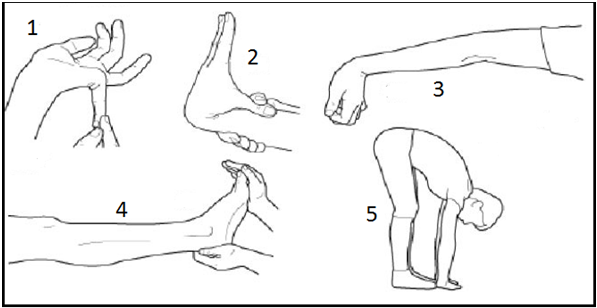
A physiotherapist, she proceeded to ask me a number of questions about my history, and finally she challenged me to touch my thumb to my forearm, as in figure 2 below:
Taken from www.physio-pedia.com. And yes, I can do all that other stuff as well, in case you were wondering.
On doing this, she told me I might be hypermobile. I had no idea what that meant, so I thought nothing much of it until some months later. I was at a party in a field, celebrating the birthdays of two friends. A shout went up for help dismantling the tents, and the person next to me mentioned that they had hypermobility and couldn’t join in. “Oh, hey,” I said, “I have that too!”

My new acquaintance, it turns out, participated in some clinical trials relating to the condition. As a result, they know basically everything there is to know about it. They told me to talk to my GP and ask for a referral to the hypermobility clinic at UCLH, which is a centre of excellence in research and houses most of the few specialists active in the UK.

Despite being fortunate enough to live in London (making it more likely that I'd be referred to the right place), it took me a year to summon up the courage to ask for a referral. My GP at the time wasn’t terribly sympathetic, but grudgingly agreed to “exaggerate my symptoms” and send the referral in. A few months later, I was seen and given a formal diagnosis of Ehlers-Danlos Syndrome.

Three years later, this person and I are firm friends, and they still have a wealth of advice to give me about how to manage my condition. When my dizziness and blackouts returned after a three-year absence, they told me what they were and how to take care of myself. When I reported gut symptoms, they gave me advice on tracking my diet. Since I’ve known them, they’ve given me tips on everything from exercise to how to talk to doctors. We’ve shared joy at each other’s good days and frustrations at our setbacks, and I couldn’t put a value on their friendship.

Community has been key in my EDS experience so far. I’ve passed on the advice my friend has given me, and a little group of supportive friends has formed around me. Symptoms like fatigue, brain fog, chronic pain, anxiety and depression can be incredibly isolating, and so the Internet has also been vital, connecting me to people - often total strangers - who understand what I’m going through and can throw me a lifeline when I’m struggling. Community is often there when doctors dismiss us or won’t see the complete picture of our symptoms. It’s there when oppression comes at us from all sides of the political sphere. We have each other, and we’re holding tight.

To all my friends, on and offline, this one’s for you. You all rock.